Tidal Barrier Engineering: Armoring Coastal Metropolises
As thermal expansion and melting continental ice raise oceans, static stone dykes no longer suffice. Contemporary water cities depend on dynamic, computer-controlled tidal barriers that permit normal ecological flushing while closing instantaneously against catastrophic storm surges.
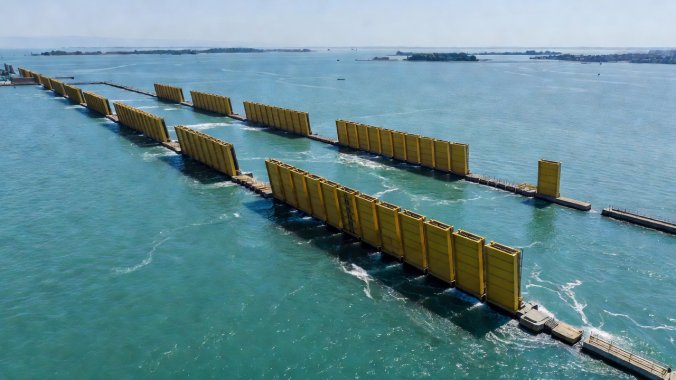
Core Hydraulic Barrier Topologies
Coastal civil engineers categorize movable storm barriers into three primary structural topologies based on gate kinematics, seabed footprint, and navigation requirements:
Submerged Buoyancy Flap Gates (Venice MOSE)
These modular steel box gates rest flat inside seabed caissons under normal conditions. When activated, water is expelled by compressed air, swinging the buoyant gates up on hinges. They leave the water surface unobstructed when dormant, allowing maritime navigation and natural tidal flushing.
Rotating Radial Sector Gates (Thames Barrier)
Curved hollow steel gates suspended between monumental concrete piers along the river channel. Normally recessed flush in the riverbed, electro-hydraulic drive units rotate the gates 90 degrees upward into position to hold back North Sea storm surges.
Floating Sector Gates (Maeslantkering, Netherlands)
Two titanic curved steel gates, each the size of the Eiffel Tower laid horizontally, rest in dry docks flanking the Nieuwe Waterweg. During extreme surges, dock basins fill with water, the massive hollow trusses float into the channel center, and valves open to sink the gates onto concrete riverbed sills.
Engineering Comparison: The World's Major Surge Defenses
| Barrier System | Location | Gate Mechanism | Span Width | Surge Resistance |
|---|---|---|---|---|
| MOSE System | Venice, Italy | 78 Submerged Buoyant Flaps | 1,600 m (across 3 inlets) | Up to +3.00 meters |
| Thames Barrier | London, UK | 10 Rotating Radial Gates | 520 meters | Up to +7.20 meters |
| Maeslantkering | Rotterdam, Netherlands | 2 Floating Sector Trusses | 360 meters | Up to +5.00 meters |
| Oosterscheldekering | Zeeland, Netherlands | 62 Vertical Sluice Gates | 9,000 meters | Up to +5.50 meters |
| St. Petersburg Dam | Gulf of Finland, Russia | Complex of 64 Sluices + 2 Radial | 25,400 meters | Up to +4.50 meters |
Ecological Trade-offs: Stagnation vs Protection
Every barrier deployment disrupts natural estuarine hydrodynamics. Closing lagoon mouths interrupts the exchange of oxygenated seawater, trapping agricultural nutrient runoff and municipal effluent within shallow basins. In Venice, frequent MOSE closures risk turning the salt marshes into stagnant lagoons prone to toxic algal blooms and oxygen depletion, compelling hydraulic teams to fine-tune activation thresholds.